I found this activity recently and thought it could make a great game for learning rooms in a house. What do you think?


Here’s a great activity that integrates Cooperative Learning and clothing vocabulary.
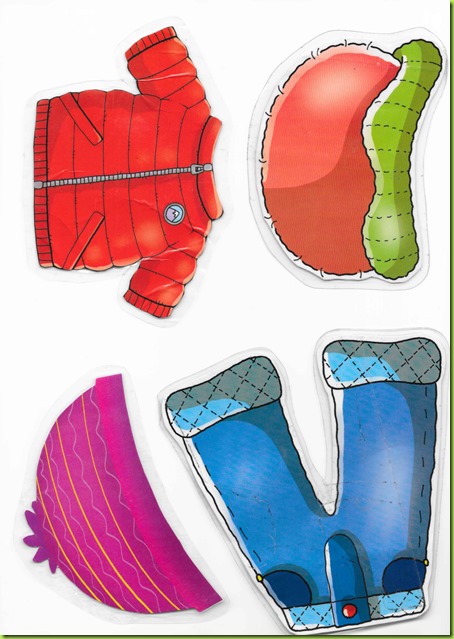
You’ll need paper dolls and paper clothes for dressing them (you can use real dolls and their clothes if you have them, of course). Feel free to print out and use the ones I have here:
You also have this version for colouring in:
So it goes like this. I divide the class into groups of 4-6 students (I do this activity with my 5-year-olds). Each group gets a paper doll. I show them the paper clothes I have in my “clothes shop”, but before “buying” them, each group needs to discuss and decide the clothing they need.
We use the “Pencils in the middle” technique for this. They each get a numbered list for taking notes (drawings) of their decisions. You can use this sheet: (cut it to get 3 lists for 3 kids):
“Pencils in the middle” is a 2-step technique. First, the group makes a decision without drawing or writing anything. Then, everyone takes a note of what has been decided.
So I would ask everyone: “What will clothing number 1 be?” Each group has to decide on the first item. After the decision has been made, they can each draw it or write it down on their list. When I see that almost everyone has finished, I call “pencils in the middle”. At that moment, kids have to put their pencils away and put their hands behind their backs (this helps them inhibit the impulse of grabbing the pencil before the group decision has been made). I would ask another question like: “What will clothing number 2 be?”, and so on, until they have 5 items of clothing on their lists.
The rules for this structure are:
While working with this technique, kids learn to compromise, come to an agreement and cooperate. See another Cooperative Learning activity HERE.
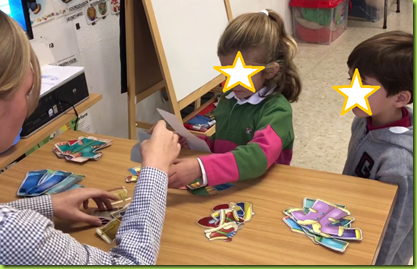
After everyone has their list ready, they take turns coming to the “shop” to buy clothes. It goes like this:
Teacher: Hello!
Student: Hello.
T: What do you need?
S: I need a sweater.
T: Here you are.
S: Thank you! (gives me some imaginary money)
T: Thank you, bye!
S: Bye-bye.
Kids get really motivated with this game, so I find it really easy to blend in some structured cooperation.
How do YOU teach clothing vocabulary? Let me know!
Here’s a great craft I tried last week: the seasons pyramid.

I did this with my 4-year-olds because we needed visual support to learn the seasons, but I recommend this craft for ages 5 and up, as their drawing skills will be more developed. As it is, we had to use stamps (snowflake, flower, sun and leaf) to make sure everyone knew what season it was. 
Here’s how you make it:
We used A3 sheets and made it a collaborative activity. We had 4 groups (one for each season), and every kid drew one thing typical of that season. Then I glued the four parts together, and now we have our seasons pyramid for the classroom.
With older students, you can also use normal (A4) sheets and have each kid make their own pyramid.
Also, this is the song we sing to learn the seasons:
Let me know what you think of the craft and of the song!
How do you teach the seasons?
Check out this video to find fun active games for your class. You’ve got activities to teach:
I love the teacher’s energy and how he encourages children to use full sentences. It definitely gave me some ideas for my class. Enjoy!
As autumn approaches, I like to think of the crafts and decorations we’ll make this year.
Here’s a poster I’ve been making for the last few years with my 3-year-olds, using potatoes cut in half and slightly carved to make the leaf shape. It’s a great way to learn some colours, and we make it listening to THIS AUTUMN SONG.
I also found this bulletin board display and I think it’s so fun! I might try it this year, maybe adding some writing.
Autumn is just around the corner! School is about to start here in Spain, and I’m looking for some inspiration for my English class.
Look at this art project! I just love it! Beauty + simplicity. You can ask kids to bring some autumn goodies to class, and then create their collage. I think this is a great opportunity to practise cooperation: a group of students can make a collage together.
Click on the picture to read the original post. It’s in Catalan but the photos are self-explanatory. The things you’ll need are few:
Use this activity to practise autumn vocabulary and understanding simple instructions. Have fun!
This booklet has been compiled to provide guidelines on provision and progression in play. Teachers can use this resource as a starting point for their planning. Also, it gives you lots of ideas for activities, resources and materiales you can use in your class.
I hope you find it as useful as I did.
Hi everyone! Just wanted to let you know about my facebook page where I share interesting articles, videos and information about teaching English, bilingualism, and education and childhood in general, in my 3 languages: English, Spanish and Lithuanian (hence the name “Trilingual treasures”).
Check it out! Please, LIKE and SHARE if you are into it! 
Our school encourages us to use Cooperative Learning techniques in the classroom.
Research shows cooperative learning helps to produce:
Some of the Cooperative Learning structures we use are:
Most of these structures have to be modified according to the age of the students if you want to use them in preschool or kindergarten. With some common sense and creativity, you will be able to put them in practice and reap the benefits of cooperative learning.
Here’s an example of how I use Pass the Paper and Pencils in the Middle with my 5-year-olds. For both activities, students were divided in groups of five.
We were learning PARTS OF THE BODY and HALLOWEEN was approaching, so I thought a monster-related activity would be perfect.
First, we used Pass the Paper to draw the monsters body. I gave each team this worksheet with the monsters head and torso. Each group only had one worksheet so they were drawing the same monster.
They had to draw the rest of the body parts, one by one. For example, one kid would say: “arms”, and she would draw the monster’s arms. Then she would pass the paper and the next kid would say: “eyes”, and he would draw the monster’s eyes, and so on.
The rules were simple:
While working with this technique, kids have to be alert to see what the rest of the group are drawing, and to be able to help if someone doesn’t remember a word in English. At the same time, some have to learn to inhibit their desire to tell others what to do, and to wait patiently for their turn.
I though the resulting pictures were very nice and creative.
For our next lesson, I made a copy of the monster for each member of the group. This time, we used Pencils in the Middle to colour the monster in. Make sure each group has crayons of each colour for everyone.
First, I asked everyone a question: “What colour are the monsters legs?” Then, each group had to decide on the colour. After the decision had been made, they could start colouring. When I saw that almost everyone had finished, I called “pencils in the middle”. At that moment, students had to put their pencils away and put their hands behind their backs (this helps them inhibit the impulse to grab the first colour they think of before the group decision has been made). I would ask another question like: “What colour are the monsters ears?”, and so on, until the monsters are coloured-in.
The rules for this structure are:
While working with this technique, kids learn to compromise, come to an agreement and cooperate.
These are the resulting monsters:

It is not easy to use these structures with little kids for the first time, you’ll have to invest time in explaining the rules and even then you’ll need to remind them constantly what to do. My students have been using Pass the Paper for two years now, and Pencils in the Middle, since last year, so they’ve had some practice.
If you decide to use Cooperative Learning in your classroom, you’ll have to be patient and persistent at first, but I assure you, as your students get older, they will reap the benefits of this active learning methodology.